Two Films From the Last Century:
John Huston’s “The Unforgiven,” 1960
Clint Eastwood’s “Unforgiven,” 1992
By Jim Harris
Cinema and Literature Curated American Culture and Mythology in the 20th Century
With the assistance of our six-foot-wide television screen and the latest online and smart-tv tools, wife Mary and I recently screened two significant motion pictures from the 20th century, two films that have almost identical titles and were released 32 years apart.
On a quiet fall afternoon and evening, we studiously watched “The Unforgiven,” 1960, and “Unforgiven,” 1992.
They both are excellent examples of how cinema and literature reflect and influence American culture while exploring the nation’s history and myths. Viewing them again after many years, and after seeing and reading hundreds of movies and books, I was reminded of several thoughts and ideas I learned about film and literature during much earlier studies.
Cinema and belles-lettres are the two dominant art forms that set perimeters for American culture and American mythology in the 20th century. They influenced just about everything, from other art forms to American beliefs, values, customs, and behaviors defining who we were and who we are. In one sense they curated the century’s culture.
For the first half of the century, from the turn of the century until the 1950s, literary works and their authors’ lives were at the center of the cultural stage. The protagonists were such prose writers as Ernest Hemingway and William Faulkner, poets such as T.S. Eliot and Robert Frost, and dramatists such as Tennessee Williams and Arthur Miller, each of them a national literary icon.
In the second half of the century, from the 1950s to the more recent 2000 fin de siecle, cinema became the most influential cynosure and loadstar in American culture. As film was growing-up and maturing in the first half of the 20th century, it was maturing and moving into adulthood in the following fifty years.
Beginning in the 1950s, American film production and film directors, such as John Houston, Francis Ford Coppola, Martin Scorsese, Steven Spielberg, and Clint Eastwood were influencing hundreds of other filmmakers who were polishing, purifying, and adding to American myths, their interpretations and meanings, while they were refining and growing an art form that seemed to be made for Americans and their history.
Film, the new art that had not existed before the century, appeared to have come magically from America’s soil and its cultural genome, and it had come-of-age in a very short period of time. The nation’s literature had been around for three hundred years; today, film has entertained and enlightened only for approximately one hundred years.
Interestingly, many of the first and best films of the century came from borrowing and adapting literary works, something they continue to do today.
I first saw “The Unforgiven” at Dallas’s Majestic Theater when I was in high school, in 1960, and I first saw “Unforgiven” at a UA Cinema in Lubbock, Texas, in 1992, the year it was released, and a year I was teaching literature and writing classes at a junior college in Hobbs, New Mexico, my home since 1974.
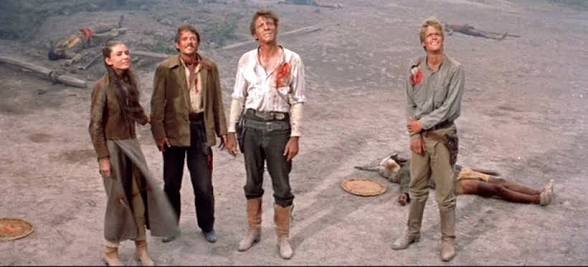
Both of the films are westerns, a stable film genre for most of the century. Both have talented, seasoned, award-winning directors, and casts. Set in the Southwest after the Civil War, “The Unforgiven” was directed by John Huston and starred, among other well-known actors, Burt Lancaster, Audrey Hepburn, Audie Murphy, and Lillian Gish. Filmed in Durango, Mexico, it is the story of a Kiowa baby girl taken in as an infant and raised by a white ranching family who is in conflict with their neighboring frontier families because the family was raising an Indian, a western plot found in several popular western movies.
Filmed in British Columbia, Canada, “Unforgiven” was directed by Clint Eastwood and stars Eastwood, among other award-winning actors, including Morgan Freeman, Gene Hackman, and Richard Harris. Its plot also is familiar frontier story—an aging outlaw-gunfighter takes on one last money-paying, illegal job before he retires to farm life.
“The Unforgiven” is a very early modern motion picture in which the director is still struggling to find his way to creating a fully-developed work of art. In the filming, Huston dealt with many technical hurdles of the times, and a production company managed by men with film ideas and ideals from the 1940s and earlier.
However, for me it remains a fine study, a riveting reviewing, in part because it is so obvious that the talented director Huston is aware of just how complex the familiar plot of the script can be. Based on a 1957 novel by Alan LeMay, the story deals with such subjects as the frontier myth, Christian theology, American frontier history, national mythology, and its story is carried along by such deep cultural currents as shared tales, beliefs, narratives, and folkways. This cowboy-and-Indian movie ends with a massive slaughter, with the Native Americans, of course, suffering the largest loss, a number as high as at least a major band of Kiowa on the Southwestern Southern Plains.
I think “The Unforgiven” is a film with a plot and theme complex enough to deserve an entire book. For its sophistication and heterogeneity, it could easily be the subject of a film student’s dissertation.
As an illustration of its intricacy, for Americans the word “unforgiven” connotes Christian stories, myths, and theology, even though the specific word is not found in the King James version of the Bible. In that version of Christianity’s sacred book, the words “unremitted” or “not remitted,” are the synonyms used to describe those who will not be making it to heaven after death.
One passage in the New Testament’s John 20:23 sums up much of the central theme in “The Unforgiven.” Of course, it has to do with importance of forgiving sins, and the idea circulates in just about every scene and each shot of the two-hour, five-minute movie:
“Who soever sins ye remit, they are remitted unto them, and whosesoever sins ye retain, they are retained.”
However, having seen a dozen or more of his movies, I do not think Eastwood had in mind the passage from the book of Saint John when he was writing and directing the script of his 1992 motion picture. It is “Unforgiven,” minus the article “the,” with implications for several of the film’s themes.
This movie faired much better with the critics and with audiences than did “The Unforgiven.” At the Academy Awards for that year, it was named Best Picture of the year, with Eastwood getting the Best Director award, Best Supporting Actor for Gene Hackman, and Best Editing by Joel Cox. Eastwood was nominated for Best Actor. It has been so popular, it remains a money-making movie over three decades after it was released.
The Internet contains a long list of dissertations written about Eastwood’s motion pictures, with subjects such as “Repercussion of Violence,” and “A Portrait of the Artist as an Old Man,” and “The Actor With No Name,” and “No Such Thing as Heroes,” and “Masculinity in the Post-war Western,” and “The Ethical Vision of Clint Eastwood.”
To keep this essay brief, I am including only a short list of some the American history and culture that Eastwood delivers in his remarkable western, a work of art described by some as not only the greatest western film, but perhaps the best of all American films.
“Unforgiven” offers the viewer at least a dozen subjects central to the American history residents remember in national myths, particularly those myths that were generated from the American frontier experience. They include how our frontier was unique in worldwide migrations, and how extreme violence concludes most of the chapters in our nation’s history.
As was the case at the end of the wars with Native Americans on the plains; as was the case at the end of the Revolutionary War and the Civil War; as was the case with World War I and World War II; and as was the case with several smaller-scale wars, such as Iraq, there was blood of copious amounts and with hundreds of thousands of soldiers and civilians killed.
The plot of “Unforgiven” ends with former outlaw and fast-gun William Munny, (Eastwood) shooting all of the bad guys, all the unforgiven, in the western town of Big Whiskey, including ex-outlaw and sheriff Little Bill Daggett (Hackman). To top off the killings, Munny announces that if anyone in town still alive attempts to shoot at him, he will not only kill that man, but also will kill his wife and children and burn his house down. Munny rides off into the sunset with half the population of Big Whiskey lying dead in the street and on the sidewalks.
This essay began with a reference to culture being shared beliefs, values, customs, behaviors, and arts. Culture is a word that refers to subjects much larger than such arts as painting, music, history, literature, although those qualities in human lives often depict the traditions, customs, and practices we favor. “Unforgiven” ends with a sacrificial, blood-bath scene that concludes many traditional American stories.
Cinema and literature have had such an impact on me, I find it almost impossible to imagine American history today without recalling both the cinema and our literature produced during the past century-and-a-quarter. The two arts are part of my cultural roadmaps to the present and to understanding our roots.
To conclude, watching movies on a leisurely fall afternoon are natural experiences for Mary and me. Traditionally, October is a month of remembrances, reflections, and celebrations. The fact that the two films we watched contain much sorrow and violence does not stop us from asking more abstract questions about our lives, art, and history.
What might replace these two cultural boundary markers, literature and history, in the future? Will there be different types of narratives recounting our traditions, customs, and practices? Could they be more visual than verbal, more verbal than visual, or an art form that combines the two?